Southern California Avocado Growers Benefit From The Healthy Soils Program Incentives Grant
By Erin Stone, Education & Community Engagement Manager with contributions from Natalie Mazur, Bilingual Environmental Educator
Finalized May 2026
Researched and written by Solana Center for Environmental Innovation, a
Technical Assistance Provider for the Healthy Soils Program Incentives Grant
(760) 436-7986 ex. 711

Introduction
In order to thrive, avocado trees require well-draining and aerated soil that does not compact easily, and their shallow, highly-sensitive roots are subject to root rot if these needs aren’t met. Both compost and mulch can provide much-needed temperature, moisture, and nutrient regulation to create ideal crop conditions, as well as weed and pest prevention. California Department of Food and Agriculture’s Office of Agricultural Resilience and Sustainability offers financial support via their Healthy Soils Program Incentives Grants to farmers, ranchers, and growers who wish to implement a variety of soil amendment practices on their land. Solana Center interviewed two avocado growers in Southern California to learn how the Healthy Soils Program (HSP) grant funding enabled them to apply compost and mulch to their fields, reducing water needs, enriching soil, and increasing yields.
Mulch Benefits an Organic Avocado Farm
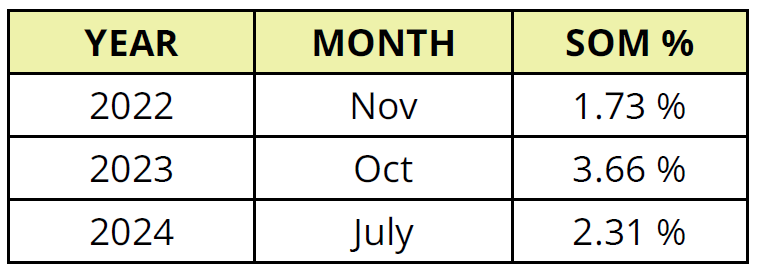
Incorporating mulching into farming practices has various benefits. It regulates moisture levels, preventing evaporation and increasing soil water holding capacity, ultimately reducing irrigation needs as well as runoff, leaching, and erosion issues. Mulch also functions as a natural weed and disease suppressant, which is of particular value to certified organic operations and those who wish to avoid synthetic herbicides. Mulch can also contribute to slow, long-lasting soil health, adding to the soil’s organic matter and nutrient content as the mulch slowly breaks down. Maria Loera-Ortiz was awarded wood chip mulching through HSP for her hilly 13-acre avocado orchard in Riverside County. Loera-Ortiz’s orchard has exclusively grown avocados for over two decades, and has been certified organic for just over 4 years. In order to cultivate healthy, high-yield trees while maintaining the orchard’s organic certification, mulching was essential to protecting the highly-sensitive avocado roots and keeping the trees healthy and disease-free. Loera-Ortiz applied mulch to her property in both rows and alleys at a rate of approximately 11 tons/acre and a depth of 3"- 4". Within the first year, Maria noted a marked drop in irrigation needs, alongside an overall increase in Soil Organic Matter (SOM) results.
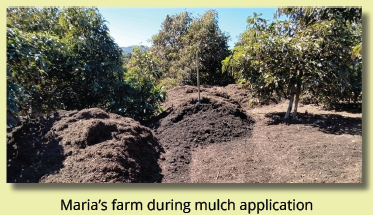
Maria plans to incorporate regular mulch application into her orchard operations, and intends to add in compost application to further support the soil and orchard health of her organic orchard.
Location: Riverside County
HSP Practice Implemented: Orchard and Vineyard Mulching (Wood Chips)
Cultivating Rich Soil
After investing in her 12-acre farm in Fallbrook 14 years ago, avocado farmer Jennifer Bantle has faced production and tree health challenges. After years of drought, increased water costs, soil water evaporation, and tip burn, the conditions were difficult. On top of these expenses, the market competition with imported avocados added pressure. Bantle Avocado Farm ended up removing several past-peak avocado trees due to their excessive water needs, leaving very few mature fruiting trees, and needed to wait until those younger trees matured. Through her Healthy Soils Program Incentives grant, Bantle was able to turn the tide for her soil. With this award, she applied greeenwaste-based compost and mulch to her orchard in hopes of increasing soil health and water retention. Results were apparent within the first year. The measured soil organic matter increased, the avocado trees were looking greener with less severe tip burn, and by the third year, the landscape was lush and green, with no more tip burn. Bantle noticed a significant reduction in irrigation needs, further lowering her expenses, as her irrigation was sinking into the soil and being retained. In parts of the farm after rain, she didn’t need to water for four months.
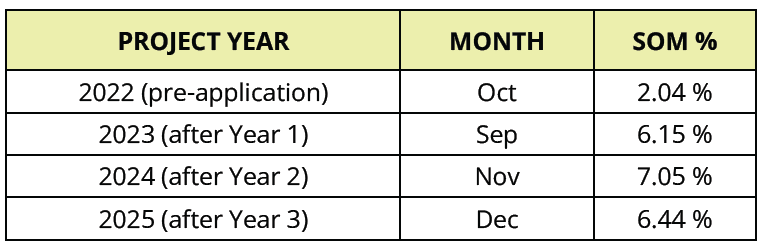
Fruit production increased significantly once these practices were implemented, and the farm’s 2025 yield produced 87,000 pounds of fruit, the highest yield Bantle had ever seen on her farm. Locally renowned soil health and compost expert Dr. Craig Kolodge, PhD, commented that the soil on Bantle’s farm was “some of the richest soil [he’d] ever seen in San Diego County.” While Bantle Avocado Farm continues to face market competition and increasing water costs, as faced by so many avocado growers in the region, she sees firsthand the immense value and impact of grants like these. ”We are super grateful,” Bantle commented.
Location: San Diego County
HSP Practices Implemented: Purchased Compost and Mulching (Natural Materials)